Double HH Manufacturing Creates Opportunities

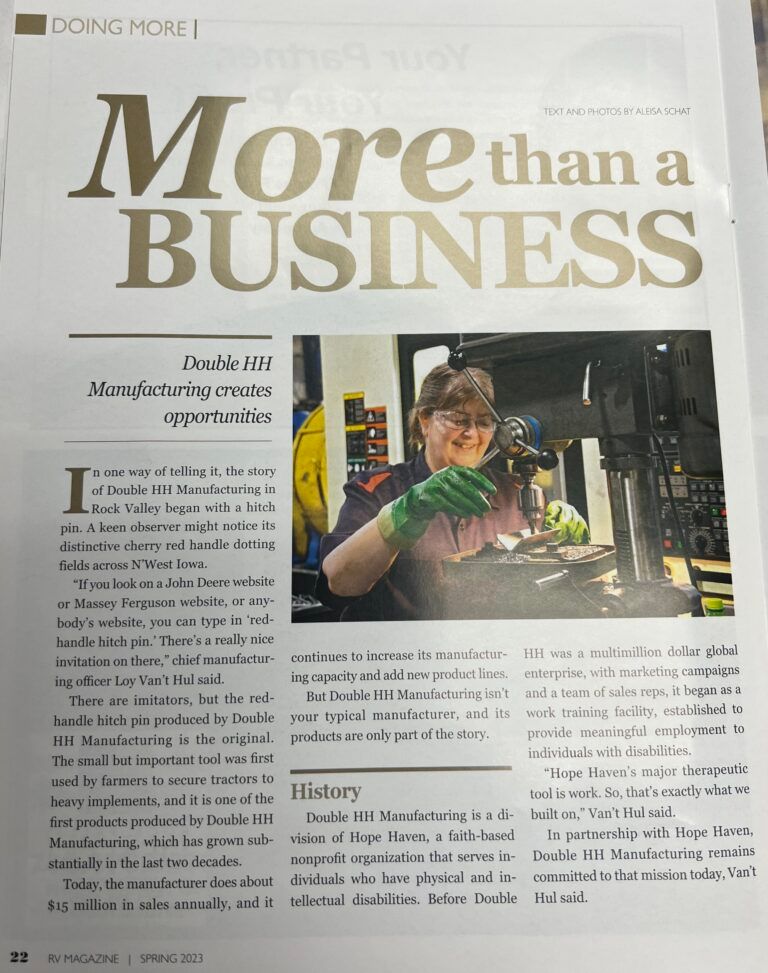
In one way of telling it, the story of Double HH Manufacturing in Rock Valley began with a hitch pin. A keen observer might notice its distinctive cherry red handle dotting fields across N’West Iowa.
“If you look on a John Deere website or Massey Ferguson website, or anybody’s website, you can type in ‘red-handle hitch pin.’ There’s a really nice invitation on there,” chief manufacturing officer Loy Van’t Hul said.
There are imitators, but the red-handle hitch pin produced by Double HH Manufacturing is the original. The small but important tool was first used by farmers to secure tractors to heavy implements, and it is one of the first products produced by Double HH Manufacturing, which has grown substantially in the last two decades.
Today, the manufacturer does about $15 million in sales annually, and it continues to increase its manufacturing capacity and add new product lines. But Double HH Manufacturing isn’t your typical manufacturer, and its products are only part of the story.
Nonprofit manufacturer
Double HH Manufacturing is a division of Hope Haven, a faith-based nonprofit organization that serves individuals who have physical and intellectual disabilities. Before Double HH was a multimillion dollar global enterprise, with marketing campaigns and a team of sales reps, it began as a work training facility, established to provide meaningful employment to individuals with disabilities.
“Hope Haven’s major therapeutic tool is work. So, that’s exactly what we built on,” Van’t Hul said. In partnership with Hope Haven, Double HH Manufacturing remains committed to that mission today, Van’t Hul said.
Founded in Rock Valley in 1984, Hope Haven serves people of all ages who have physical and intellectual disabilities, providing opportunities for employment, vocational training, community living, respite care and mental health services.
The faith-based nonprofit organization serves more than 1,500 children and adults in N’West Iowa and Minnesota. “There’s really only one place where we learn how to work — that’s when somebody shows us how,” Van’t Hul said.
Accommodations are made for employees when they need tham, but that’s not the focus at Double HH Manufacturing, according to Van’t Hul. “I am really not too interested in what a person can’t do,” Van’t Hul said. “I’m more interested in what a person can do. We’ve always kind of used that approach.”
History
In 1998, Hope Haven’s Work Training Center became Double HH Manufacturing, and it moved from its original location, adjacent to the organization’s main office, to a spec building in Rock Valley’s industrial park located at 207 Westview Drive. “We’re wholly owned by Hope Haven, but what it does is it allows us to market ourselves out in the world just a little bit,” Van’t Hul said.
Products produced by Double HH Manufacturing would have their own brand identity, and customers could purchase them like they would purchase any other product. All revenue is reinvested in Hope Haven’s mission: to provide meaningful employment and vocational training to individuals with disabilities. To stay true to its mission, Van’t Hul said, Double HH Manufacturing needs to operate as efficiently and successfully as any for-profit business.
“At the end of the day, customers want their parts made right and shipped on time — and that’s at a competitive cost,” Van’t Hul said. “But we don’t hide the fact that we’re providing services for people with disabilities.”
Van’t Hul, who celebrated his 40th year with Hope Haven this year, came on board in 1983, before the manufacturing facility had been moved to its present location and dubbed Double HH. “When I started, I entered every order of products; I printed every label for every product when we came out with it,” Van’t Hul said. “We’ve grown quite a bit.”
When it first opened in its new location, Double HH had around 30 employees. Today, that number has more than doubled, and the manufacturer employs more than 60 people, many who have disabilities. For many years, Double HH has maintained an integrated model of operation, and employees who receive disability services work side by side with employees who do not. That growth can be traced back to one important catalyst: the red hitch pin.
The red hitch pin
In the late 1970s, Hope Haven worked in partnership with Rock Valley-based Kooima Company to produce a hitch pin used by local farmers. When the center of the Kooima manufacturing business drifted toward other products in the early 1970s, however, Hope Haven inherited the hitch pin and a couple of the machines needed to produce it. “The owners of Kooima said, ‘Why don’t you take this on?’ and they gave us the hitch pin to manufacture and sell.” retired plant manager John Wallenburg said.
At first, the hitch pin was sold directly to area farmers, who essentially became field testers for the product. They provided feedback about what they did and didn’t like about the pin, and Hope Haven employees at the Work Training Center continued to revise and refine the product until the farmers were satisfied. “If you listen to everything your customer says, and you keep eliminating excuses, eventually they’ve got to buy it,” Van’t Hul said with a laugh.
Ultimately, employees working in Hope Haven’s work training facility developed a pin with a larger handle and collar, which makes it easier to grip. They also began heat treating it to improve its performance in the field, reducing its susceptibility to wear and tear. Finally, they coated it in red plastisol, a liquid into which each pin is dipped before the liquid is cured with heat to become solid plastic.
“You make it, you do it again — eventually, there’s no excuse but to buy it,” Van’t Hul said. That all took place before Van’t Hull’s time, but it was just the beginning. “The hitch pin kind of exploded from there,” Wallenburg said. “We started getting requests for quotes from other people who asked if we could make a certain type of pin.”
Today, Double HH Manufacturing sells more than 400,000 red-handle hitch pins a year. Originally available in six sizes, the hitch pin today is available in 21.
Growth
Over the decades, Double HH Manufacturing diversified its product line to include other kinds of pins, non-threaded fasteners and tractor three-point linkage parts. “We make round things, right?” Van’t Hul said. Those round things are tiny feats of engineering, and they are produced on a vast manufacturing floor.
“We’ve always approached this like, ‘Hey, we make hitch pins, and then we developed some more products along the way,’” Van’t Hul said. “About half of our business is on the stock-product side, which would be the hitch pin, and the other half of our business is making parts for a lot of different industries.”
The ag market makes up about 40 percent of sales, but parts made by Double HH are used in a wide variety of industries to produce a wide variety of things. Double HH produces the component parts used in exercise equipment, recreational vehicles, military equipment and heavy-duty trucks. “There’s probably a 60 percent chance that a diesel truck that you meet today will have parts made by Double HH,” Van’t Hull said.
Double HH Manufacturing also produces a part used in the wheel-lubricating mechanism in railroad locomotives, and the red-handle hitch even makes an appearance in military conflict zones across the globe. A small framed photo that sits next to a product display on the floor at Double HH Manufacturing pictures a Humvee in Afghanistan, attached to a military trailer that is secured with a cherry-red hitch pin. Some products historically produced by Double HH can no longer be produced economically on its manufacturing floor, so they outsource the production of several products and resell them. “We do that as a service to our customers,” Van’t Hul said.
However, Double HH Manufacturing continues to produce most of its product lines in house. As the business continues to grow, its physical footprint is growing, too. A 35,000-foot expansion under construction will be completed this spring or summer, increasing the manufacturer’s warehouse and manufacturing space to about 78,000 square feet. “All those sales numbers and employment numbers are a measurement of doing little things right. Every day,” Van’t Hul said.
Little things
Profits are important — they ensure the viability of the business going forward. But doing little things right everyday is in the service of something bigger than profits, Van’t Hul said. Double HH Manufacturing provides people with disabilities the opportunity to take pride in doing good work, to earn a full-time income and to establish a degree of financial independence.
“There has been a lot of good leadership on the part of Hope Haven,” Van’t Hul said. “The board members and administrators have always seen the value of work for all persons.
“Rather than say, ‘Well, no, you can’t work because you have this limitation,’ they say, ‘You deserve the same opportunity to enjoy a discretionary income. Maybe you want to buy a car or a house — or to get married.’ It’s really the same things we all want in life.”
Article by Aleisa Schat, Rock Valley Magazine
The post Double HH Manufacturing Creates Opportunities appeared first on Hope Haven.